When delving into the world of brickwork and stone construction, you'll likely encounter technical terms that aren't part of everyday language. One of the most fundamental is the "wythe." But what is a wythe, and why is it so important for the structure and performance of your walls?
At MidRender, we believe in empowering our clients with knowledge. This guide will break down this essential masonry concept in simple, clear terms.
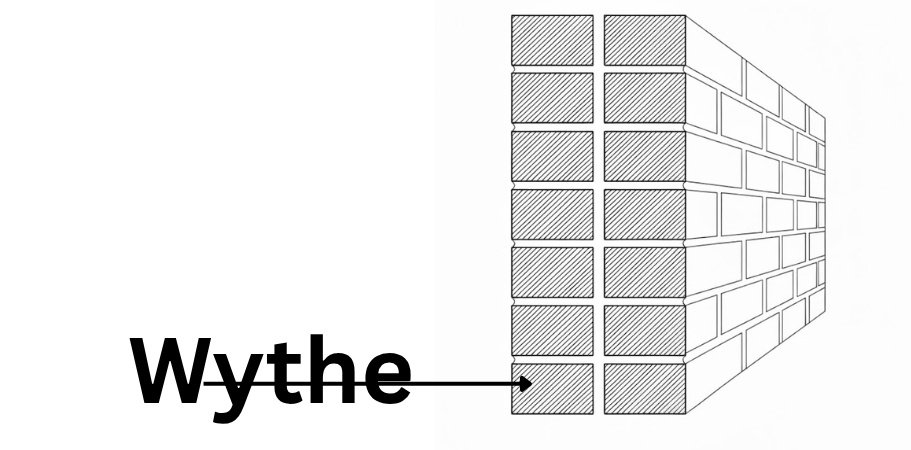
In its simplest form, a wythe (pronounced like "with" or "withe") is a continuous vertical section of a masonry wall that is one unit thick.
Think of a single row of bricks laid end to end. That row is part of a larger, vertical layer. That entire vertical layer—a single brick thick—is a wythe. It is the basic building block of masonry construction.
Visual Analogy: If a masonry wall were a sandwich, a wythe would be a single slice of bread. A wall can be made from one slice (single wythe) or two slices with a filling in between (multi-wythe).
The number of wythes in a wall defines its type, strength, and function. Here’s the key difference:
A single wythe wall is exactly what it sounds like: a wall consisting of just one layer of masonry units. It is primarily a single, structural layer.
A multi-wythe wall consists of two or more wythes laid up together. This is the standard for traditional, durable, and high-performing building exteriors.
When you have more than one wythe, they need to be bonded together to act as a single, cohesive structural unit. This is done in a few ways:
Knowing this term helps you understand the construction of your own home and communicate more effectively with builders and surveyors.
It's most commonly pronounced to rhyme with "lithe" or "withe" (like "with" a soft 'th'). Some also pronounce it like "with." Both are generally accepted.
Yes, absolutely. A standard cavity wall is a two-wythe wall. The inner leaf (often blockwork) is one wythe, and the outer leaf (brick) is the second wythe, with the cavity between them.
A course is a horizontal layer of bricks or stones. A wythe is the entire vertical section that is one unit thick. A single wythe is made up of many courses stacked on top of each other.
It can be, but its load-bearing capacity is limited. For the main structural walls of a building in the UK, building regulations typically require the greater strength and stability of a multi-wythe (cavity) wall construction.
Most traditional UK homes built before the 1920s with solid brick walls are two wythes thick, bonded together with headers. Some older, more substantial buildings may have three or even more.
Understanding the structure of your walls is the first step in maintaining them, improving their efficiency, or planning an extension. Whether you're dealing with a single wythe garden wall or the complex multi-wythe system of your home, the experts at MidRender can help.
Contact us today for a consultation. We can help you assess your masonry construction and find the right solutions for your project.